Thursday, March 26, 2009

Two-Pronged Approach for Greening China’s Buildings, Part 1: The LEED Snowball

This is the first of a three part post on my "two-pronged approach" for greening China’s buildings. The two-pronged approach consists of both a bottom up and a top down strategy for transforming the market for green buildings in China. The first post will focus on how China has achieved its success with LEED buildings thus far and what this says about market transformation. The second post will describe the need for bottom up green leadership by real estate developers and describe some policy steps to encourage this. The third post will make the case that particularly in China, this bottom up approach is not nearly enough and introduce a top down approach to supplement the bottom up approach.

LEED in it’s current incarnation is most certainly not the end goal of the green building movement. LEED doesn’t go nearly far enough: even if every building globally achieved the 33% energy savings common in LEED buildings, the world would still be far from achieving the CO2 emission reductions needed to forestall the worst effects of global warming. However, LEED has been an important stepping stone in the journey toward a green built environment. Importantly, LEED has provided a good real world case study in how to successfully transform parts of the real estate market. By studying how LEED transformed the US real estate market and parts of the Chinese real estate market, we can better design a plan for transforming the rest of the Chinese market and achieving the vision of green buildings for everyone, everywhere.

The LEED snowball
LEED has seen massive growth in the US and globally. LEED registrations, i.e. projects committing to seek LEED certification (and paying money to say so), grew from 1000 in 2006 to over 20,000 in 2009. The Green Building Impact Report estimates that "new construction sector penetrations [are] approaching a whopping 40%." This seemingly unstoppable growth is a lot like a snowball rolling down a hill. MIT’s Peter Senge describes the snowball concept in his recent book The Necessary Revolution:
Snowballs arise from an underlying system structure where change feeds on itself to produce more of the same, and soon it snowballs into a pattern of self-reinforcing growth.
The underlying system structure of the market for LEED-rated green buildings is a snowball with two parallel and complementary feedback cycles that drive growth.

The first cycle is the demand side. As more green buildings are built, tenants begin to occupy that space and benefit from the green features. As these benefits become publicized and more widely understood, more tenants demand green buildings. Thanks to increased demand, developers build more green buildings. The cycle builds on itself, and the result is more green building.
At the same time, there is a parallel supply side cycle. As more green buildings are built, developers and builders begin to learn how to make green buildings better and more cheaply. As a result, more tenants can afford green buildings and therefore demand for green buildings increases. This cycle also builds on itself, and the result is more green building.
More importantly, these two cycles reinforce each other and will eventually result in green building becoming the standard in the market place. The result of this snowballing growth then is nothing less market transformation. The snowball feedback loop helps explain the explosive growth in LEED building. In other words, once the snowball gets big enough, nothing is going to stop it from rolling down the hill. This holds true not only in the US, but also in Tier 1 Chinese Class A markets like Beijing and Shanghai. The same dynamics even seemed to be at work in Dubai before its real estate market collapsed.


The need for snowballs
Interestingly, LEED has achieved this snowballing growth from the bottom up. LEED filled an unmet need in the market place and was able to tap a nascent demand for better, healthier and greener office space. Although the federal and state governments certainly played a role in helping LEED along in the US, the heavy lifting was really done from the bottom up. And in China, besides the Ministry of Science and Technology’s role in Accord 21, almost nothing was done on the part of the government to promote LEED, which illustrates just how thoroughly bottom up LEED’s growth has been in China.

In my next post, I will build on these principles of snowballs market transformation to introduce the “bottom up” approach to achieve snowballing growth in the Chinese building markets that are currently being left untransformed.

Tuesday, March 17, 2009

Green Buildings for Everyone, Everywhere: How China Can Achieve This Vision

I was recently in Hong Kong and Macau at the Fulbright midterm research conference. When talking with my fellow Fulbrighters, I was often asked to describe my research findings about green buildings thus far. This event was a great chance for me to reflect upon what I’ve learned about green buildings during my time in China. Sometimes in the course of focusing on specific topics on my blog, I lose track of the bigger picture. This post will describe the key findings from my research so far: while China has made progress with green buildings, it hasn’t gone nearly far enough. I will focus the rest of my time here on finding solutions to how China can realistically tackle the many barriers to green buildings and achieve a vision of green buildings for everyone, everywhere.

Buildings are huge polluters
When people imagine the chief causes of greenhouse gas emissions in China, many think of coal power plants. While true on the surface, this popular perception misplaces the real blame. After all, where does that electricity produced by coal power plants ultimately go? To power buildings, primarily. The reality is, the energy used in buildings- both in their operation and construction- represents almost 45 percent of China's total annual energy use and a similar share of China’s greenhouse gases. This means that buildings in China alone account for more greenhouse gas emissions than all of Japan and Russia, combined. In addition to greenhouse gas emissions, buildings also consume large amounts of land, water and material resources.

More and more buildings
The environmental impact of buildings is growing rapidly. According to McKinsey, China will have one billion urban residents by 2030. Providing housing and employment for the urban billion will require China to continue its unprecedented construction boom. The result will be an estimated 40 billion square meters of construction between now and 2030, spread over 5 million new buildings.

Although China currently boasts one of the lowest building energy uses per capita, this is quickly changing for two primary reasons. First, as incomes rise, Chinese are demanding more and more floor space per capita. For example, floor area per capita in Beijing doubled from 2001-2006. The result is more buildings and therefore more energy use per capita.

Second, as services like heating, cooling and hot water become more common, each square foot is using more energy. According to Lawrence Berkeley National Labs, only 20% of office buildings nationwide had cooling in 2000. By 2020, this is expected to nearly triple to 55%. The result will be much more energy use per square meter. For example, highly-developed Shanghai’s energy consumption per square meter increased 31% from 1998 to 2005 thanks to a mix of increased energy use for heating, cooling, lighting and water heating. As other cities and provinces catch up with Shanghai and demand similar levels of comfort, this will result in continued increases in energy intensity nationwide.

When this data is coupled with the growth in overall floor area, the energy use and greenhouse gas emissions scenarios for China’s buildings look bad. Add to this mix the fact that inefficient buildings built today will continue to pollute and use energy for 40+ years, and the situation is downright scary.

LEED Silver lining not nearly enough
Despite this dirty and worsening picture of China’s built environment, there is a small bright spot emerging: the number of LEED-certified high performance green buildings in China is growing rapidly.

LEED-rated buildings can save significant energy, water, and materials resources and reduce carbon dioxide emissions. LEED first came to China in 2006 when the Ministry of Science and Technology demonstration building called Accord 21 achieved a LEED Gold rating, using 73% less energy than the average government building in Beijing and 60% less water.

Since Accord 21’s completion, LEED has seen dramatic growth in China. As of February 2009, over 118 Chinese buildings had registered to seek LEED certification, and many more businesses have registered their intent to green their offices according to LEED standards. In fact, Rob Watson, an international green building expert, estimates that over 50% of class A office building coming online in Beijing and Shanghai over the next two years will seek LEED certification. This is fantastic news, almost on par with American cities noted for their greenery, like New York or Portland.


The problem is, this high level of penetration is primarily confined to the tier 1 cities. LEED projects have sprouted up in tier 2 cities like Tianjin and tier 3 cities like Wuhan, but most LEED buildings continue to be in the highly developed areas near Beijing, Shanghai and Shenzhen. This is problematic because the vast majority of building is occurring outside of these tier 1 regions. Moreover, the growth in construction in the tier 2 and 3 cities is actually much faster than that in tier 1 cities, meaning more construction will be in these secondary markets in the future.


More worrisome is the fact that LEED buildings are almost exclusively confined to the high-end of the market: Class A office, luxury apartments, and factories owned by multinational corporations. Unfortunately, this does not even come close to covering the entire market. The urbanization statistics shown earlier imply that a significant amount of space is going to have to be created for people who have yet to be urbanized. This certainly won’t be luxury apartment space. And what about for all those companies not ready or willing to occupy Class A office space? While 100+ LEED buildings is promising, this is nothing compared to the 5 million buildings to be built between now and 2030.

Clearly, LEED alone cannot even begin to stem the tide of increasing greenhouse gas emissions and energy use in Chinese buildings. Unfortunately, while the government continues to show strong interest in building energy efficiency programs, I haven’t seen much happening outside of LEED.

What's next
China should not accept this state of affairs. Much, much more can and must be done to reduce the environmental impact of China’s buildings. Green buildings for everybody, everywhere will have to be the goal for China to reduce greenhouse gas emissions and other environmental impacts while making room for unprecedented urbanization.

But how can China spread green buildings to Tier 2 and 3 cities and the countryside? How can China spread green buildings to all segments of the market? How can they do it within the timeframe needed to avoid locking-in future carbon emissions and prevent catastrophic global warming? Most importantly, how can they transform the market at an acceptable cost, or even at a net benefit?

Trying to answer these questions will be the focus of the rest of my blog posts and my research in China.

Sunday, March 8, 2009

Steven Holl Strikes Again- Shenzhen’s Vanke Center Aiming for LEED Platinum

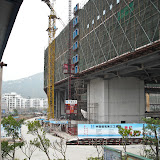
Steven Holl didn’t stop with the Linked Hybrid in Beijing, he is also the architect for the Vanke Center in Shenzhen, a new mixed-use “horizontal skyscraper” aiming for LEED Platinum. I was lucky enough to visit the construction site last week, and this post will describe the unique concept and display some of my photos.


(Quick caveat: most of this info was provided to me in Chinese... I’m pretty good with the language, but I might have missed something...)

“Horizontal Skyscraper” Maximizes Open Space
The Vanke Center, despite being only 35m tall, is one of the largest skyscrapers in the world. It just happens to be horizontal. In fact, if the Vanke Center were stood up vertically, it would be as tall as the Empire State Building. The building houses apartments, condos, offices, and a hotel, and will be the new headquarters for China Vanke, one of the country's largest real estate developers.


And in addition to just looking cool, this interesting form actual has multiple green functions.

Open space
The building essentially has zero footprint on the ground, which creates more space for social interaction as well as more greenery. Although this landscaping could create additional environmental pressures, the designers have thoughtfully minimized this impact through the use of a rainwater capture system. Shenzhen’s wet, tropical climate provides plenty enough rain to keep the plants green, and rainwater gutters on the roof collect this water and use it for irrigation and filling the several fountains throughout the grounds. Moreover, the additional green space means there is more opportunity for rain water to percolate into the ground before running off into local sewers, lessening the strain on municipal water infrastructure.


rain water collection

Second, the raised building creates a cool microclimate beneath it. The building is sited at the foot of a fairly large hill, and the raised structure allows cool breezes from the hill to pass through the open area. This cools the building and reduces the need for air conditioning during the hot Shenzhen summers. It also creates for a more comfortable outdoor experience, encouraging more occupants and visitors to take advantage of the extra open space.


Third, the raised structure creates the largest possible number of views. Since the building’s lowest floor is at the same height as an average building’s third floor, more occupants have views to the outside. When coupled with daylight sensors, this means less energy used for lighting the indoor spaces. Moreover, the raised structure also creates “floorlights” on the first floor, whereby light bounces up from the open space below to provide additional natural light. Significant skylighting on the roof provides additional light, and louvered windows and double-paned glass allow in maximum light while minimizing glare. The result is a highly productive and comfortable space that uses less energy and is better connected with it’s outdoor environment.


"floorlights" to be

windows with louvers shown blocking out glare

skylighting on the roof can replace significant indoor lighting


Fourth, the horizontal design creates much more rooftop space. Holl takes advantage of this roof space in two ways. First, the building has a significant rooftop solar panel installation. These PV panels provide 12% of the power for Vanke’s offices. And where PV panels aren’t installed, the rest of the roof sports a roof garden. This green roof will reduce the building’s cooling load and keep additional rainwater from entering the sewers.


Housing for solar panels

All these green features that flow from the building’s interesting design, as well as a few more interior features like underfloor air distribution and thermal energy storage, contribute to the building’s lofty green goal: LEED platinum. (Note: the building is actually split into 4 different buildings, and only Vanke’s offices will be going for LEED platinum. I’m a bit confused about the split and will try to find out more.) The building was originally scheduled to be completed in mid-2009, but has been pushed back to late 2009 or early 2010. I guess that means the race between the Vanke Center and Parkview Green is on to be the first LEED Platinum building in China.

Vanke Center
Link to full photo slideshow of my site tour

Vanke
This building represents another step forward for Vanke, one of the biggest developers in China. Vanke was the second company to list on the Shenzhen stock exchange in 1991, and was the most valuable company on the exchange in 2006. It develops residential real estate all over China, accounting for about 2% of China’s residential real estate market. That may not sound like much, but is huge for a market as fragmented as Chinese real estate. As a result, what Vanke does sets a tone for the entire market.

This is not Vanke’s first green project. Vanke has been exploring prefabricated housing to cut down on materials waste, and received an Architectural Record Best Client award in 2008 for their commitment to good design. This makes sense, since Vanke manages all its properties, which gives them incentive to make their properties profitable over the long-run.

Vanke is an established leader in the real estate market, and I think the cutting-edge Vanke Center will really get other developers thinking about how they can implement green principles into their own projects. Cheers to Vanke for pushing the envelope. Let's hope other developers follow suit.

Thursday, February 26, 2009

EcoBlocks

This post will describe the Eco Block concept and what the government will have to do to encourage developers to build with this type of whole-systems design.

EcoBlocks
EcoBlocks aim to be mass replicable, economically viable, and nearly entirely resource self-sufficient communities. EcoBlocks are an alternative way to meet the huge and growing demand for urban space in China, currently filled by inefficient and wasteful apartment blocks. The EcoBlock concept is still a only a concept, but it’s creator Harrison Fraker, former dean of the UC Berkeley School of Architecture, has worked with Arup to prove the concept and is in talks with various Chinese cities to build an EcoBlock. The slide show below is Professor Fraker’s full introduction to the concept, and I will focus on a few key slides in my post today.


Whole Systems Design
Professor Fraker has done a masterful job of using whole systems thinking to design the EcoBlock. As the schematic below shows, the EcoBlock considers the many interactions between the energy, water, and waste systems. The anaerobic digester is a prime example: water used to flush the toilets goes into the septic tank as waste, which then goes through the digester where it is turned into energy. This is an interesting example of “waste equals food”, a concept Will McDonough and Michael Bruangart champion in Cradle to Cradle.


The upshot of this whole systems thinking is a development that is almost entirely self-sufficient from a resource perspective. As the chart below shows, thanks to significant energy efficiency measures and on-site generation, EcoBlocks is a net-zero energy community and doesn’t need to be connected to the grid.


As a result of water conservation measures and extensive on-site treatment, EcoBlocks are entirely self sufficient from a water perspective. The EcoBlock also tries to close the waste loop. All sludge, food waste, and green waste is sent to the digester where it is used for energy generation. Unfortunately, the waste loop is not completely closed, and about 17% of the complex’s waste (primarily non-recyclable solid waste) will have to be sent to the landfill.

The EcoBlock’s community design aims to create a pedestrian-friendly environment, maximizing the room for social interaction and minimizing emissions related to automobiles.

First costs
But of course, the primary barrier keeping EcoBlocks from moving from concept to reality is cost, or rather, the distribution of costs and benefits among different players.


The EcoBlock’s additional sustainability initiatives are expected to increase the upfront costs by 5-10% over a standard development. On it’s face, that seems pretty remarkable: a completely net-zero energy and water and nearly net-zero waste community for just 5-10% more than a standard resource-inefficient development.

But an extra $7 million in upfront development capital can significantly affect the project’s economics: Professor Fraker estimates that this investment will take a 10.1 year payback period. 10 years is a long time for developers anywhere, and light years in China’s fast-moving development market, and is likely to be a big deterrent to Chinese developers.

But the real financial barrier with the EcoBlocks is not necessarily this cost increase per se, but rather a mismatch between costs and benefits. All the costs- solar panels, digesters, wind turbines, wastewater treament facility, etc- are borne by the developers. On the other hand, most of the benefits are enjoyed by either the tenants or the government.

The benefits that flow to the tenant are obvious: a net-zero energy and water community means no monthly electricity or water bill. Theoretically, these utility saving benefits could potentially be capitalized upfront and included in the price of the units. However, that would likely make the units prohibitively expensive for the average urban Chinese resident, limiting the usefulness and scalability of the EcoBlock model.

Most likely, government support in the form of a financial subsidy to developers will be needed to get EcoBlocks off the ground. Luckily, I think the government has a real incentive to do this. Besides the many obvious environmental benefits of this type of development, the EcoBlock could also save the government a lot of money in capital spending. Since EcoBlocks are net-zero energy and net-zero water, the government doesn’t have to provide any power or water infrastructure to the community. If many communities pursued this mode of low-impact development, this could result in the reduction of an entire water treatment plant or coal-fired power plant, saving the government significant amounts of infrastructure spending. Government therefore has an economic incentive to encourage mass implementation of EcoBlock-like low-impact communities.

The chart below shows one kind of government subsidy model that Fraker envisions. Essentially, the government gives a financial subsidy to the developer, who is then incented to build a resource efficient EcoBlock development. After completion, users pay the developer a phantom “utility bill” to the developer instead of a real utility bill. Essentially, the idea is for those who get the long-term benefit (government, users) to pay the developer, the actor with the most control over the design.


The future role of government in green building
Thus far, the green real estate market in China (and the US to a lesser extent) has consisted almost entirely of Class A office buildings and luxury apartments in Tier 1 cities. Developers are willing to build green for these high-end markets because they can make more money in three primary ways: higher rents since companies will pay more for green space; lower operating costs as a result of lower energy bills; and a better competitive position thanks to the green features.

But green buildings cannot just be an isolated, high-end phenomenon; in the future every building- from the cheapest hutong all the way to the most luxurious hotel- will need to be green. And for that vision to be achieved, green building payoffs can't be based on higher rents alone.

The Asia Business Council’s report on green buildings showed that investing in energy efficiency is 4-6x cheaper than investing in new power plants. The problem is, this statistic takes the societal viewpoint. From the viewpoint of the average Chinese developer, sustainability is an extra cost and the benefits will be enjoyed by somebody else. Government must step in and change this economic calculus: In order for developments like the EcoBlock to be competitive and mass-replicable in the short term, the government must step in and provide financial incentives to developers.

But maybe it doesn’t have to be the Chinese government. The recent Brookings Institution report on overcoming obstacles to US-China cooperation on climate change recommends that the US and China announce a major headline green initiative that “capture[s] the public’s imagination”. Could EcoBlocks in China- and financial incentives from the American government to build them- fit the bill?

Tuesday, February 24, 2009

Ministry of Construction Green Building Evaluation Standard- The “Three Star” System

Today’s post will describe China’s green building evaluation standard and compare it the US Green Building Council’s LEED rating system.

An English translation of the Chinese rating system can be found here:

Part 1: full rating system

Part 2: notes and scoring system

(note: from the google doc's site, you can download the rating system in PDF or Word)

The Three Star System
The Ministry of Construction’s Green Building Evaluation Standard is China’s first attempt to create a local green building standard. As the introduction of the rating system notes, the purpose is to create a voluntary rating system that will encourage green development:
Our country is now in the phase of rapid economic development, ranking world No. 1 in terms of annual building volume, with significantly growing consumption of resources year by year. Therefore, scientific development philosophy must be steadily created and seriously implemented, and the concept of sustainable development must be adhered to, to strongly develop green buildings... The purpose of formulating this standard is to regulate evaluation on green buildings and promote the development of green buildings.
The evaluation system, introduced in 2006, is credit-based, and allows developers to choose which credits they want to pursue.

The evaluation system has two different standards: one for residential buildings and one for public (i.e. large commercial) buildings. As the rating system describes,
Considering current construction market in our country, this standard will mainly evaluate residential buildings that are huge in quantities and public buildings that consume much energy and resources, like office buildings, mall buildings and hotel buildings. For evaluation on other buildings, this standard can serve as reference.
The evaluation standard rates buildings with a variety of prerequisites (called “control items” in the Chinese system) and credits (called “general items” in the Chinese system) in six categories:
  1. Land savings and outdoor environment
  2. Energy savings
  3. Water savings
  4. Materials savings
  5. Indoor environmental quality
  6. Operations and management
A seventh category called “Preference items” contains strategies that are both cutting-edge and harder to implement, such as brownfield redevelopment, more than 10% on-site renewable power generation, etc.

The China green building system grants three levels of ratings: 1-star, 2-star, and 3-star, hence the nickname “Three Star System”. The charts below show the different ratings for residential and public buildings:


Similarities between Three Star System and LEED
Those familiar with the LEED rating system will notice many striking similarities between LEED and the China standard.

First, both are credit based systems rather than command and control systems. This gives the developer maximum leeway over what credits they wish to pursue, although some critics of LEED have said this reduces the level of sustainability in LEED rated buildings. China’s system does have more prerequisites (32 in residential, 26 in public buildings) than LEED (7 in LEED for New Construction [PDF]).

Second, the categories are almost the same, save for the Three Star's additional operations and management category. Moreover, the credits within those categories are very similar; things like minimum energy performance, water savings, local materials, and others are seen in both systems.

Third, the rating categories are very similar: 1-, 2- and 3- stars in the Chinese system and Certified, Silver, Gold and Platinum in LEED.

Complement to LEED
One interesting aspect of the Three Star System is that it a rating can only be awarded after one year of property operation:
Evaluation on newly built, expanded or reconstructed residential buildings and office buildings, mall buildings and hotel buildings belonging to public buildings, shall be conducted in one year after turnover to the property owner.
I think this is a good idea for China, because it requires real, measurable reduction. One complaint about LEED is that many credits are based on energy savings predicted by energy modeling, rather than actual certified energy savings. Although New Buildings Institute data [PDF] shows that on average, the models accurately predict energy savings, this can vary widely on a building to building basis. The Three Star System remedies this by basing results on hard data, and collection of this data may be an important first step toward better measurement of building energy use in China.

However, I worry that this post-facto certification process could slow the market transformation that LEED has driven so efficiently in America. The LEED Core and Shell system allows developers to submit their design and achieve “pre-certification”, which they can then market to prospective tenants before the building is built. This allows developers to capture some of the benefits of going green by getting higher rents and faster lease up and ultimately drives more developers to build green.

Luckily, LEED and China’s Three Star System can work together and complement each other quite nicely. This will allow developers who want to get the marketing benefits of green to pursue LEED Core and Shell pre-certification and then ensure that the predicted energy savings were achieved by going for Three Star certification.

As Rob Watson, “father of LEED” and CEO of EcoTech International, a green building consultancy in the US and China, says:
I really don't see LEED or other international green building standards as "competing" with the MOHURD [Three Star] green standard. The real competition is with the standard non-green developments. The MOHURD [Three Star] green standard is more geared for the Chinese market and should appeal to a broader base of developers than LEED. However, key segments of the market are demanding LEED and everyone agrees that the market should not be interfered with. I also believe that, as the cost to certify comes down, I expect the reach of China's green standard and LEED to expand.
Watson expects to pursue both the Three Star standard and LEED standards on the projects he works on in China.

All in all, the Three Star System seems to be a good start for China’s nascent green building market. As the market begins to accept this system, I hope we will see the Three Star System begin to gain popularity and become much more widespread than LEED, which still remains almost exclusive to Class A office and luxury apartment development. After all, for China to get serious about green development, all buildings will have to be green, not just those at the top end of the market. Hopefully the Three Star System will eventually help make the Chinese real estate market greener, healthier and more prosperous.

Monday, February 23, 2009

Building combined heat and power: a key strategy for GHG reduction in China

This post will describe building combined heat and power (BCHP) and what role it could play in helping China reduce it’s emissions in the near term, and also what role it can play in laying the groundwork for China to significantly reduce it’s emissions in the long term.

BCHP
Building combined heat and power (BCHP) refers to technologies that simultaneously provide both electricity and heating and/or cooling inside buildings. The idea is pretty simple: take all the waste heat that comes from normal power generation processes and use it for something useful, namely heating the building. Using the fuel for two processes really drives efficiency. Most BCHP systems operate between 70% and 90% efficiency, as compared to the mid-50% range for high efficiency natural gas plants and the mid-30% range for a standard coal plant.

Buildings are uniquely well-suited for combined heat and power because they almost always need both electricity and heat and/ or cooling (the thermal heat can be used to drive cooling processes). Generally, BCHP systems are sized to provide enough power to the building to match the building’s electrical or thermal baseload, i.e. the lowest amount of energy that will be used during the day or throughout the year. BCHP will provide the baseload and then the grid or other onsite renewables will provide power to meet peak loads.

CHP is not new to China, although it has primarily been used in larger applications, and not sized down to the building level. According to a recent report led by the US EPA (PDF), China already produces 13.5% of it’s electricity from CHP units. Most of this CHP capacity is coal-fired district heating units. The report notes that although China’s share of CHP electricity generation is growing,
China [still] has a large district heating sector that relies primarily on heat-only boilers, rather than on more efficient and less polluting CHP. Compared to other countries with large district heating sectors and many industrial consumers of heat, China has a relatively low share of CHP in both electricity and heat production.
So although I will focus on BCHP in this post, wider adoption of CHP for district heating would help reduce the energy use and carbon emissions related to the inefficient Chinese space heating system I described last week.

BCHP advantages
BCHP are good sources of carbon reductions for two reasons. First, the high efficiency of BCHP means 25% less fuel is used for the same level of heating and electricity as compared to conventional separated heat and power systems. 25% less fuel means 25% less emissions, both global GHG emissions and locally harmful pollutant emissions. Second, the fuel for BCHP is most often natural gas, which provides even further emission savings. Since natural gas is cleaner than coal, ie produces less CO2 per unit of energy, this “fuel switching” provides additional GHG reductions. As this analysis by the World Alliance for Distributed Energy (WADE) shows, BCHP could save significant amounts of carbon emissions in China:


Importantly, unlike other “clean” fossil fuel technologies like coal CCS, BCHP is a well proven technology, with many units around the world working reliably. The US already gets about 8% of it’s electricity from CHP, most of which is in the form of distributed BCHP units. Transferring this know-how from the US to China could be a key piece of a program of technology transfer that must be expanded as a centerpiece of US-China collaboration on climate change.

Most importantly for China, the economics work for BCHP. As the WADE analysis shows, the cheapest way for China to meet its expected electricity demand in 2020 is through DE, or distributed energy, such as BCHP, thanks to much lower transmission and distribution (T&D) costs:


So as China inevitably gets serious about reducing emissions, BCHP as well as community level CHP will be one of the obvious places to start. Indeed, China’s NDRC has already announced a goal of 200 GW of CHP generation by 2020, which is expected to account for 22% of installed power capacity at that time.

Is CHP a good long-term strategy?
Although BCHP would certainly be a good step forward in the sense that it results in serious emissions reductions in the short-term, one problem is that it might be considered a “second best” solution over the long-term. As Michael Hoexter wrote recently in Green Thoughts,
A carbon pricing system, especially in its first years, will encourage investment in what might be called “local minima” or the currently less expensive carbon reduction technology or practice. In some cases, these local minima may be zero-carbon or potentially part of a net zero carbon emitting economy, but in most cases these choices will entail the more efficient use of fossil resources or switching to “second-best” alternative fuel systems like substituting natural gas for petroleum... However commitments to second-best, long-lived infrastructure with a useful lifetime of 40 or 50 years that commits us to a lot of carbon emissions during that period appear to be ultimately a waste of resources.


The 25% GHG emissions reduction that BCHP provides is certainly a big reduction, but does not get to the 80% below 1990 CO2 emissions levels by 2050 considered necessary by IPCC scientists. Of course, if China were also to switch from coal to natural gas as they move to BCHP, the emissions savings could be even larger and make BCHP look better.

However, widespread fuel switching in China would depend heavily on a serious build out of natural gas infrastructure. According to the US EPA report, natural gas only provides about 3% of China’s current energy needs, although this figure has been growing recently.

China is also pouring lots of money into building out its natural gas infrastructure. But in a zero carbon world, it seems likely that even natural gas will eventually have to be abandoned, making it a “second best” option and ultimately a waste of resources. On the other hand, WADE suggests that since natural gas is limited, China should maximize the value out of it by investing in high-efficiency BCHP:
The fact that gas reserves are located in western China and the biggest demand for gas use in buildings is in the eastern part of the country means that bringing gas to market requires large-scale capital investment. To get the most value from infrastructure investment the Chinese will want to ensure it is burned in a manner which minimizes waste. BCHP is perhaps the best application for optimising the value of the incoming gas supplies.
Biofuels and biodiesel may also soon become low-carbon realities and help displace some of the natural gas requirements. Although given the water difficulties China is facing, I find it hard to believe that biofuels will be anything but a “second best” solution for China.

CHP is a good move forward for China
Despite the serious issues relating to fuel above, I believe BCHP is a key step toward the long-term imperative of a carbon neutral China for three reasons.

First, a build out of BCHP will provide a learning curve for the Chinese to figure out how to make distributed generation work. As I mentioned in my post on the Pearl River Tower, China’s current grid policy does not allow for “running the meter back”, which prevented the installation of CHP at that project. If China starts ramping up BCHP, this policy will likely be changed as more and more building owners will want to have both BCHP and access to the grid. Moreover, China's grid operators do not have much experience integrating distributed and centralized power generation. More grid-connected BCHP would push grid operators and regulatory bodies to create a "smart grid" that can seamlessly take both distributed and centralized power and provide it to customers. A smarter, more interconnected grid is a key part of further development of net zero energy buildings and distributed renewable power generation, which will likely be the centerpieces of a future low carbon society. BCHP would be a good next step toward a smart grid.

Second, wide scale installation of BCHP will help slow the growth of coal plants and avoid “locking in” future CO2 emissions. BCHP technology is a proven, cost-effective way to reduce China’s carbon emissions in the short-term. Given China’s still unresponsive attitude toward climate change, BCHP likely represents one of the few real short-term alternatives to continued growth in Chinese coal power plants.

Third and most importantly, BCHP will spur more systems thinking, particularly a focus on the inherent linkages between power plants and buildings. For most of the modern area, power plants have been built further and further afield. This makes obvious sense for coal plants, since no one wants a coal plant and all the emissions it produces in their backyard and would much rather have it “out of sight and out of mind”. However, with much cleaner burning BCHP power generation, the logic of far flung power starts to disappear and “relocalizing” generation begins to make sense. As power generation becomes relocalized and integrated into buildings, designers will be forced to think about the buildings energy load and how to provide the power for that load. In the extreme, if it becomes the norm for building owners to foot the bill for their power rather than just outsource it to utilities, designers will become much more conscious of the energy impact of their design decisions.

Ultimately, better design will have to be the solution to the climate crisis. Widespread adoption of BCHP and relocalization of power generation are steps China can take right now to help drive better design.

Friday, February 20, 2009

Heating in China- Inefficiency and Opportunity

Today’s post will focus on China’s extraordinarily inefficient heating system and how to fix it.

Heating in China

Due to China’s geography, heating is required in many regions of the country. As the map below shows, much of China faces cold winters, some of which are severely cold. According to the World Bank, 19% of residential floor area is in “severe cold” regions and 27% is in “cold” regions. As a result, significant amounts of space heating is required to keep occupants comfortable (I use the term “comfortable” verrry loosely, as I will touch on later).


Nowadays heating is slowly creeping southward and entering the “hot summer and cold winter” zones. There was no provision of central heating in these regions until the very late 1990’s, and central heating remains limited. But it’s clear that as China (and particularly southern and central coastal China) continues to get richer, citizens throughout the nation will clamor for more comfortable condition. This China Daily editorial nicely captures that sentiment in it’s title: “freezing Shanghai needs central heating”.

Since the hot summer and cold winter zone accounts for 37% of China’s residential floor area, this southward trend has the potential to dramatically increase the amount of heating in China. Indeed, LBL expects space heating (PDF) to be in 55% of Chinese commercial buildings by 2020, up from 35% in 2000, “as the country’s ‘heating zone’, historically limited to northern China, continues to expand into many southern regions.”


Heating is inefficient and uncomfortable
The problem is China’s space heating is extremely energy inefficient. Wang Qingqin of the Chinese Academy of Building Research estimates (PDF) that buildings in China use 2-3x more energy per square meter for heating than buildings in comparable temperature zones in Europe or the US.

Yet despite all that extra energy use, thermal comfort is significantly lower in China.
Why is this? Well, a number of causes actually. Some central heating systems don’t allow for user control of the heat, so sometimes windows have to be opened to compensate, which is an obvious waste of energy. The billing system also doesn’t help, which I’ll explain later. But certainly the major cause of this inefficiency is extremely poor insulation in Chinese buildings.

Poor insulation


As the results of the Asia Business Council expert interviews above show, the primary factor affecting a building’s heating load is the building envelope and the insulation it provides between the interior of a space and the outdoor environment. The worse the insulation, the more energy transfer between the indoor and outdoor environment. When it’s cold outside, this means the cold air comes in, and the hot air goes out, resulting in a lot of wasted energy as well as occupant discomfort.

As the graph below shows, insulation in Beijing (and the rest of China) is significantly worse than the developed world’s, and allows much more heat (in the form of energy) to escape to the outside.

Graph based on data from Chinese Academy of Building Research

My anecdotal evidence backs this up: I can feel the cold when I put my finger against the glass of almost any window in Beijing, even in high-end apartment buildings. One major exception thus far was the Linked Hybrid, which as I mentioned here, focused on high-quality insulation.

Insulation is a great investment
Investing in improved insulation is a win-win-win, resulting in higher thermal comfort for occupants, and less energy use and GHG emissions at low cost.

Insulation works “year round”, in the sense that improved insulation reduces heating energy use in the winter, but also reduces cooling energy use in the summer. This is really important, since as we can infer from the LBL graph above, in addition to the southward creep of space heating units, there is also a northward creep of air conditioning units.

Maybe the best part about investments in insulation is that they are also a win financially. As the McKinsey global GHG abatement cost curve below shows, investments in insulation are one of the lowest cost sources of carbon emission reductions available.


The need for government policy
So why isn’t their more investment in good insulation, or even more importantly, why isn’t it just built into the buildings from the beginning?

This is primarily a question of government policy. Theoretically, the government mandates higher levels of insulation, but due to lack of enforcement, these levels are not achieved. But as I will describe in a post next week on building codes, many if not most buildings in China don’t actually meet code.

Just as important is the inefficient pricing system for heating in the northern part of the country. The Chinese government views provision of heat in the north as a public good, and therefore has historically mandated that Chinese companies provide heating for their employees. After reforms to that system in 2007, heat is now paid for by tenants, but is still generally sold per the square meter, rather than by the BTU or the KWH. Under this system, no matter how much or little heating a Chinese apartment actually uses, the heating charge is still the same. This helps explain the lack of insulation.

Given the lack of proper pricing structure, there is no financial incentive for the building owner or an ESCO to invest in better insulation. This is why developers usually just skimp upfront on proper insulation. To make matters worse, since Chinese building codes theoretically mandate higher levels of insulation, CDM financing cannot be used to bring these buildings up to code (although as I wrote in a previous post, this should be changed to reflect the reality of the code compliance situation in China).

Luckily, the slow gears of policy change are starting to turn. The government is convinced of the need to price heat properly, and is now just figuring out how to roll out the system without harming low-income Chinese. As this China Daily article noted, some residents already struggle with their heating bill:
But low-income households still find it tough to afford. "We will have to pay 1,700 yuan (US$ 210) for the heating of a 70 square-metre flat under the new system," said 45-year-old laid-off worker Jiang Yongfu in Beijing. "That's almost triple my monthly income."
Hopefully along with pricing heat properly, the government can also start a weatherization program to help lower-income residents like Jiang upgrade their insulation and save money by using less heat.